Dataset Viewer
Duplicate
The dataset viewer is not available for this split.
Cannot extract the features (columns) for the split 'train' of the config 'default' of the dataset.
Error code:   FeaturesError
Exception:    ArrowInvalid
Message:      JSON parse error: The document is empty.
Traceback:    Traceback (most recent call last):
                File "/usr/local/lib/python3.12/site-packages/datasets/packaged_modules/json/json.py", line 174, in _generate_tables
                  df = pandas_read_json(f)
                       ^^^^^^^^^^^^^^^^^^^
                File "/usr/local/lib/python3.12/site-packages/datasets/packaged_modules/json/json.py", line 38, in pandas_read_json
                  return pd.read_json(path_or_buf, **kwargs)
                         ^^^^^^^^^^^^^^^^^^^^^^^^^^^^^^^^^^^
                File "/usr/local/lib/python3.12/site-packages/pandas/io/json/_json.py", line 791, in read_json
                  json_reader = JsonReader(
                                ^^^^^^^^^^^
                File "/usr/local/lib/python3.12/site-packages/pandas/io/json/_json.py", line 905, in __init__
                  self.data = self._preprocess_data(data)
                              ^^^^^^^^^^^^^^^^^^^^^^^^^^^
                File "/usr/local/lib/python3.12/site-packages/pandas/io/json/_json.py", line 917, in _preprocess_data
                  data = data.read()
                         ^^^^^^^^^^^
                File "/usr/local/lib/python3.12/site-packages/datasets/utils/file_utils.py", line 813, in read_with_retries
                  out = read(*args, **kwargs)
                        ^^^^^^^^^^^^^^^^^^^^^
                File "<frozen codecs>", line 322, in decode
              UnicodeDecodeError: 'utf-8' codec can't decode byte 0xe5 in position 35: invalid continuation byte
              
              During handling of the above exception, another exception occurred:
              
              Traceback (most recent call last):
                File "/src/services/worker/src/worker/job_runners/split/first_rows.py", line 228, in compute_first_rows_from_streaming_response
                  iterable_dataset = iterable_dataset._resolve_features()
                                     ^^^^^^^^^^^^^^^^^^^^^^^^^^^^^^^^^^^^
                File "/usr/local/lib/python3.12/site-packages/datasets/iterable_dataset.py", line 3496, in _resolve_features
                  features = _infer_features_from_batch(self.with_format(None)._head())
                                                        ^^^^^^^^^^^^^^^^^^^^^^^^^^^^^^
                File "/usr/local/lib/python3.12/site-packages/datasets/iterable_dataset.py", line 2257, in _head
                  return next(iter(self.iter(batch_size=n)))
                         ^^^^^^^^^^^^^^^^^^^^^^^^^^^^^^^^^^^
                File "/usr/local/lib/python3.12/site-packages/datasets/iterable_dataset.py", line 2461, in iter
                  for key, example in iterator:
                                      ^^^^^^^^
                File "/usr/local/lib/python3.12/site-packages/datasets/iterable_dataset.py", line 1952, in __iter__
                  for key, pa_table in self._iter_arrow():
                                       ^^^^^^^^^^^^^^^^^^
                File "/usr/local/lib/python3.12/site-packages/datasets/iterable_dataset.py", line 1974, in _iter_arrow
                  yield from self.ex_iterable._iter_arrow()
                File "/usr/local/lib/python3.12/site-packages/datasets/iterable_dataset.py", line 503, in _iter_arrow
                  for key, pa_table in iterator:
                                       ^^^^^^^^
                File "/usr/local/lib/python3.12/site-packages/datasets/iterable_dataset.py", line 350, in _iter_arrow
                  for key, pa_table in self.generate_tables_fn(**gen_kwags):
                                       ^^^^^^^^^^^^^^^^^^^^^^^^^^^^^^^^^^^^
                File "/usr/local/lib/python3.12/site-packages/datasets/packaged_modules/json/json.py", line 177, in _generate_tables
                  raise e
                File "/usr/local/lib/python3.12/site-packages/datasets/packaged_modules/json/json.py", line 151, in _generate_tables
                  pa_table = paj.read_json(
                             ^^^^^^^^^^^^^^
                File "pyarrow/_json.pyx", line 342, in pyarrow._json.read_json
                File "pyarrow/error.pxi", line 155, in pyarrow.lib.pyarrow_internal_check_status
                File "pyarrow/error.pxi", line 92, in pyarrow.lib.check_status
              pyarrow.lib.ArrowInvalid: JSON parse error: The document is empty.

Need help to make the dataset viewer work? Make sure to review how to configure the dataset viewer, and open a discussion for direct support.
XModBench: Benchmarking Cross-Modal Capabilities and Consistency in Omni-Language Models

XModBench teaser

Paper Website Dataset GitHub Repo License: MIT

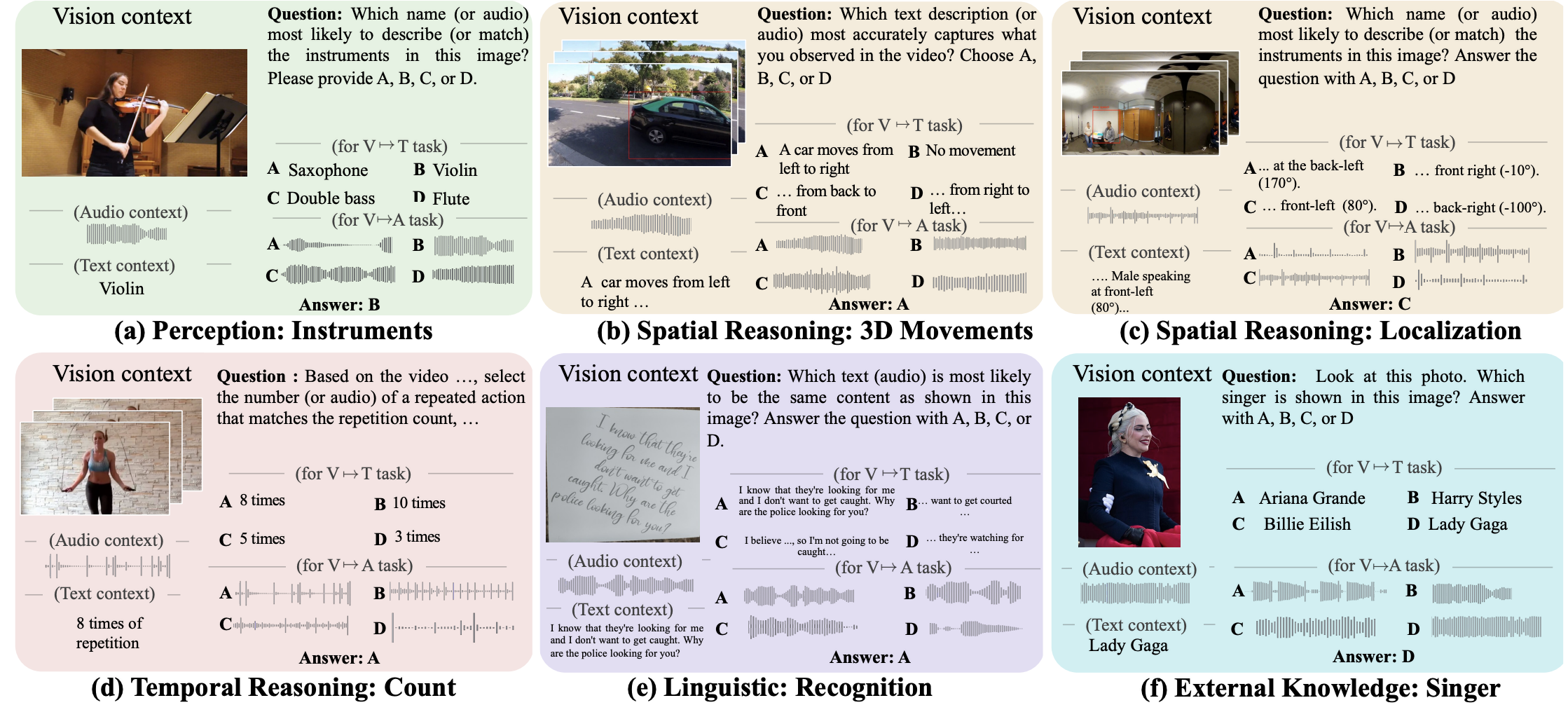
XModBench is a comprehensive benchmark designed to evaluate the cross-modal capabilities and consistency of omni-language models. It systematically assesses model performance across multiple modalities (text, vision, audio) and various cognitive tasks, revealing critical gaps in current state-of-the-art models.

Key Features

  • 🎯 Multi-Modal Evaluation: Comprehensive testing across text, vision, and audio modalities
  • 🧩 5 Task Dimensions: Perception, Spatial, Temporal, Linguistic, and Knowledge tasks
  • πŸ“Š 13 SOTA Models Evaluated: Including Gemini 2.5 Pro, Qwen2.5-Omni, EchoInk-R1, and more
  • πŸ”„ Consistency Analysis: Measures performance stability across different modal configurations
  • πŸ‘₯ Human Performance Baseline: Establishes human-level benchmarks for comparison

πŸš€ Quick Start

Installation

# Clone the repository
git clone https://github.com/XingruiWang/XModBench.git
cd XModBench

# Install dependencies
pip install -r requirements.txt

πŸ“‚ Dataset Structure

Download and Setup

After cloning from HuggingFace, you'll need to extract the data:

# Download the dataset from HuggingFace
git clone https://huggingface.co/datasets/RyanWW/XModBench

cd XModBench

# Extract the Data.zip file
unzip Data.zip

# Now you have the following structure:

Directory Structure

XModBench/
β”œβ”€β”€ Data/                              # Unzipped from Data.zip
β”‚   β”œβ”€β”€ landscape_audiobench/          # Nature sound scenes
β”‚   β”œβ”€β”€ emotions/                      # Emotion classification data
β”‚   β”œβ”€β”€ solos_processed/               # Musical instrument solos
β”‚   β”œβ”€β”€ gtzan-dataset-music-genre-classification/  # Music genre data
β”‚   β”œβ”€β”€ singers_data_processed/        # Singer identification
β”‚   β”œβ”€β”€ temporal_audiobench/           # Temporal reasoning tasks
β”‚   β”œβ”€β”€ urbansas_samples_videos_filtered/  # Urban 3D movements
β”‚   β”œβ”€β”€ STARSS23_processed_augmented/  # Spatial audio panorama
β”‚   β”œβ”€β”€ vggss_audio_bench/             # Fine-grained audio-visual
β”‚   β”œβ”€β”€ URMP_processed/                # Musical instrument arrangements
β”‚   β”œβ”€β”€ ExtremCountAV/                 # Counting tasks
β”‚   β”œβ”€β”€ posters/                       # Movie posters
β”‚   └── trailer_clips/                 # Movie trailers
β”‚
└── tasks/                             # Task configurations (ready to use)
    β”œβ”€β”€ 01_perception/                 # Perception tasks
    β”‚   β”œβ”€β”€ finegrained/               # Fine-grained recognition
    β”‚   β”œβ”€β”€ natures/                   # Nature scenes
    β”‚   β”œβ”€β”€ instruments/               # Musical instruments
    β”‚   β”œβ”€β”€ instruments_comp/          # Instrument compositions
    β”‚   └── general_activities/        # General activities
    β”œβ”€β”€ 02_spatial/                    # Spatial reasoning tasks
    β”‚   β”œβ”€β”€ 3D_movements/              # 3D movement tracking
    β”‚   β”œβ”€β”€ panaroma/                  # Panoramic spatial audio
    β”‚   └── arrangements/              # Spatial arrangements
    β”œβ”€β”€ 03_speech/                     # Speech and language tasks
    β”‚   β”œβ”€β”€ recognition/               # Speech recognition
    β”‚   └── translation/               # Translation
    β”œβ”€β”€ 04_temporal/                   # Temporal reasoning tasks
    β”‚   β”œβ”€β”€ count/                     # Temporal counting
    β”‚   β”œβ”€β”€ order/                     # Temporal ordering
    β”‚   └── calculation/               # Temporal calculations
    └── 05_Exteral/                    # Additional classification tasks
        β”œβ”€β”€ emotion_classification/    # Emotion recognition
        β”œβ”€β”€ music_genre_classification/ # Music genre
        β”œβ”€β”€ singer_identification/     # Singer identification
        └── movie_matching/            # Movie matching

Note: All file paths in the task JSON files use relative paths (./benchmark/Data/...), so ensure your working directory is set correctly when running evaluations.

Basic Usage


#!/bin/bash
#SBATCH --job-name=VLM_eval        
#SBATCH --output=log/job_%j.out
#SBATCH --error=log/job_%j.log                        
#SBATCH --ntasks-per-node=1
#SBATCH --gpus-per-node=4

echo "Running on host: $(hostname)"
echo "CUDA_VISIBLE_DEVICES=$CUDA_VISIBLE_DEVICES"

module load conda
# conda activate vlm
conda activate omni

export audioBench='/home/xwang378/scratch/2025/AudioBench'

# python $audioBench/scripts/run.py \
#     --model gemini \
#     --task_name perception/vggss_audio_vision \
#     --sample 1000


# python $audioBench/scripts/run.py \
#     --model gemini \
#     --task_name perception/vggss_vision_audio \
#     --sample 1000

# python $audioBench/scripts/run.py \
#     --model gemini \
#     --task_name perception/vggss_vision_text \
#     --sample 1000

# python $audioBench/scripts/run.py \
#     --model gemini \
#     --task_name perception/vggss_audio_text \
#     --sample 1000

# Qwen2.5-Omni

# python $audioBench/scripts/run.py \
#         --model qwen2.5_omni \
#         --task_name perception/vggss_audio_text \
#         --sample 1000

python $audioBench/scripts/run.py \
        --model qwen2.5_omni \
        --task_name perception/vggss_vision_text \
        --sample 1000

πŸ“ˆ Benchmark Results

Overall Performance Comparison

Model Perception Spatial Temporal Linguistic Knowledge Average
Gemini 2.5 Pro 75.9% 50.1% 60.8% 76.8% 89.3% 70.6%
Human Performance 91.0% 89.7% 88.9% 93.9% 93.9% 91.5%

Key Findings

1️⃣ Task Competence Gaps

  • Strong Performance: Perception and linguistic tasks (~75% for best models)
  • Weak Performance: Spatial (50.1%) and temporal reasoning (60.8%)
  • Performance Drop: 15-25 points decrease in spatial/temporal vs. perception tasks

2️⃣ Modality Disparity

  • Audio vs. Text: 20-49 point performance drop
  • Audio vs. Vision: 33-point average gap
  • Vision vs. Text: ~15-point disparity
  • Consistency: Best models show 10-12 point standard deviation

3️⃣ Directional Imbalance

  • Vision↔Text: 9-17 point gaps between directions
  • Audio↔Text: 6-8 point asymmetries
  • Root Cause: Training data imbalance favoring image-to-text over inverse directions

πŸ“ Citation

If you use XModBench in your research, please cite our paper:

@article{wang2024xmodbench,
  title={XModBench: Benchmarking Cross-Modal Capabilities and Consistency in Omni-Language Models},
  author={Wang, Xingrui, etc.},
  journal={arXiv preprint arXiv:2510.15148},
  year={2024}
}

πŸ“„ License

This project is licensed under the MIT License - see the LICENSE file for details.

πŸ™ Acknowledgments

We thank all contributors and the research community for their valuable feedback and suggestions.

πŸ“§ Contact

πŸ”— Links

Todo

  • Release Huggingface data
  • Release data processing code
  • Release data evaluation code

Note: XModBench is actively maintained and regularly updated with new models and evaluation metrics. For the latest updates, please check our releases page.

Downloads last month
162

Paper for RyanWW/XModBench

RyanWW/XModBench Β· Datasets at Hugging Face
Dataset Viewer
Duplicate
The dataset viewer is not available for this split.
Cannot extract the features (columns) for the split 'train' of the config 'default' of the dataset.
Error code:   FeaturesError
Exception:    ArrowInvalid
Message:      JSON parse error: The document is empty.
Traceback:    Traceback (most recent call last):
                File "/usr/local/lib/python3.12/site-packages/datasets/packaged_modules/json/json.py", line 174, in _generate_tables
                  df = pandas_read_json(f)
                       ^^^^^^^^^^^^^^^^^^^
                File "/usr/local/lib/python3.12/site-packages/datasets/packaged_modules/json/json.py", line 38, in pandas_read_json
                  return pd.read_json(path_or_buf, **kwargs)
                         ^^^^^^^^^^^^^^^^^^^^^^^^^^^^^^^^^^^
                File "/usr/local/lib/python3.12/site-packages/pandas/io/json/_json.py", line 791, in read_json
                  json_reader = JsonReader(
                                ^^^^^^^^^^^
                File "/usr/local/lib/python3.12/site-packages/pandas/io/json/_json.py", line 905, in __init__
                  self.data = self._preprocess_data(data)
                              ^^^^^^^^^^^^^^^^^^^^^^^^^^^
                File "/usr/local/lib/python3.12/site-packages/pandas/io/json/_json.py", line 917, in _preprocess_data
                  data = data.read()
                         ^^^^^^^^^^^
                File "/usr/local/lib/python3.12/site-packages/datasets/utils/file_utils.py", line 813, in read_with_retries
                  out = read(*args, **kwargs)
                        ^^^^^^^^^^^^^^^^^^^^^
                File "<frozen codecs>", line 322, in decode
              UnicodeDecodeError: 'utf-8' codec can't decode byte 0xe5 in position 35: invalid continuation byte
              
              During handling of the above exception, another exception occurred:
              
              Traceback (most recent call last):
                File "/src/services/worker/src/worker/job_runners/split/first_rows.py", line 228, in compute_first_rows_from_streaming_response
                  iterable_dataset = iterable_dataset._resolve_features()
                                     ^^^^^^^^^^^^^^^^^^^^^^^^^^^^^^^^^^^^
                File "/usr/local/lib/python3.12/site-packages/datasets/iterable_dataset.py", line 3496, in _resolve_features
                  features = _infer_features_from_batch(self.with_format(None)._head())
                                                        ^^^^^^^^^^^^^^^^^^^^^^^^^^^^^^
                File "/usr/local/lib/python3.12/site-packages/datasets/iterable_dataset.py", line 2257, in _head
                  return next(iter(self.iter(batch_size=n)))
                         ^^^^^^^^^^^^^^^^^^^^^^^^^^^^^^^^^^^
                File "/usr/local/lib/python3.12/site-packages/datasets/iterable_dataset.py", line 2461, in iter
                  for key, example in iterator:
                                      ^^^^^^^^
                File "/usr/local/lib/python3.12/site-packages/datasets/iterable_dataset.py", line 1952, in __iter__
                  for key, pa_table in self._iter_arrow():
                                       ^^^^^^^^^^^^^^^^^^
                File "/usr/local/lib/python3.12/site-packages/datasets/iterable_dataset.py", line 1974, in _iter_arrow
                  yield from self.ex_iterable._iter_arrow()
                File "/usr/local/lib/python3.12/site-packages/datasets/iterable_dataset.py", line 503, in _iter_arrow
                  for key, pa_table in iterator:
                                       ^^^^^^^^
                File "/usr/local/lib/python3.12/site-packages/datasets/iterable_dataset.py", line 350, in _iter_arrow
                  for key, pa_table in self.generate_tables_fn(**gen_kwags):
                                       ^^^^^^^^^^^^^^^^^^^^^^^^^^^^^^^^^^^^
                File "/usr/local/lib/python3.12/site-packages/datasets/packaged_modules/json/json.py", line 177, in _generate_tables
                  raise e
                File "/usr/local/lib/python3.12/site-packages/datasets/packaged_modules/json/json.py", line 151, in _generate_tables
                  pa_table = paj.read_json(
                             ^^^^^^^^^^^^^^
                File "pyarrow/_json.pyx", line 342, in pyarrow._json.read_json
                File "pyarrow/error.pxi", line 155, in pyarrow.lib.pyarrow_internal_check_status
                File "pyarrow/error.pxi", line 92, in pyarrow.lib.check_status
              pyarrow.lib.ArrowInvalid: JSON parse error: The document is empty.

Need help to make the dataset viewer work? Make sure to review how to configure the dataset viewer, and open a discussion for direct support.

XModBench: Benchmarking Cross-Modal Capabilities and Consistency in Omni-Language Models

XModBench teaser

Paper Website Dataset GitHub Repo License: MIT

XModBench is a comprehensive benchmark designed to evaluate the cross-modal capabilities and consistency of omni-language models. It systematically assesses model performance across multiple modalities (text, vision, audio) and various cognitive tasks, revealing critical gaps in current state-of-the-art models.

Key Features

  • 🎯 Multi-Modal Evaluation: Comprehensive testing across text, vision, and audio modalities
  • 🧩 5 Task Dimensions: Perception, Spatial, Temporal, Linguistic, and Knowledge tasks
  • πŸ“Š 13 SOTA Models Evaluated: Including Gemini 2.5 Pro, Qwen2.5-Omni, EchoInk-R1, and more
  • πŸ”„ Consistency Analysis: Measures performance stability across different modal configurations
  • πŸ‘₯ Human Performance Baseline: Establishes human-level benchmarks for comparison

πŸš€ Quick Start

Installation

# Clone the repository
git clone https://github.com/XingruiWang/XModBench.git
cd XModBench

# Install dependencies
pip install -r requirements.txt

πŸ“‚ Dataset Structure

Download and Setup

After cloning from HuggingFace, you'll need to extract the data:

# Download the dataset from HuggingFace
git clone https://huggingface.co/datasets/RyanWW/XModBench

cd XModBench

# Extract the Data.zip file
unzip Data.zip

# Now you have the following structure:

Directory Structure

XModBench/
β”œβ”€β”€ Data/                              # Unzipped from Data.zip
β”‚   β”œβ”€β”€ landscape_audiobench/          # Nature sound scenes
β”‚   β”œβ”€β”€ emotions/                      # Emotion classification data
β”‚   β”œβ”€β”€ solos_processed/               # Musical instrument solos
β”‚   β”œβ”€β”€ gtzan-dataset-music-genre-classification/  # Music genre data
β”‚   β”œβ”€β”€ singers_data_processed/        # Singer identification
β”‚   β”œβ”€β”€ temporal_audiobench/           # Temporal reasoning tasks
β”‚   β”œβ”€β”€ urbansas_samples_videos_filtered/  # Urban 3D movements
β”‚   β”œβ”€β”€ STARSS23_processed_augmented/  # Spatial audio panorama
β”‚   β”œβ”€β”€ vggss_audio_bench/             # Fine-grained audio-visual
β”‚   β”œβ”€β”€ URMP_processed/                # Musical instrument arrangements
β”‚   β”œβ”€β”€ ExtremCountAV/                 # Counting tasks
β”‚   β”œβ”€β”€ posters/                       # Movie posters
β”‚   └── trailer_clips/                 # Movie trailers
β”‚
└── tasks/                             # Task configurations (ready to use)
    β”œβ”€β”€ 01_perception/                 # Perception tasks
    β”‚   β”œβ”€β”€ finegrained/               # Fine-grained recognition
    β”‚   β”œβ”€β”€ natures/                   # Nature scenes
    β”‚   β”œβ”€β”€ instruments/               # Musical instruments
    β”‚   β”œβ”€β”€ instruments_comp/          # Instrument compositions
    β”‚   └── general_activities/        # General activities
    β”œβ”€β”€ 02_spatial/                    # Spatial reasoning tasks
    β”‚   β”œβ”€β”€ 3D_movements/              # 3D movement tracking
    β”‚   β”œβ”€β”€ panaroma/                  # Panoramic spatial audio
    β”‚   └── arrangements/              # Spatial arrangements
    β”œβ”€β”€ 03_speech/                     # Speech and language tasks
    β”‚   β”œβ”€β”€ recognition/               # Speech recognition
    β”‚   └── translation/               # Translation
    β”œβ”€β”€ 04_temporal/                   # Temporal reasoning tasks
    β”‚   β”œβ”€β”€ count/                     # Temporal counting
    β”‚   β”œβ”€β”€ order/                     # Temporal ordering
    β”‚   └── calculation/               # Temporal calculations
    └── 05_Exteral/                    # Additional classification tasks
        β”œβ”€β”€ emotion_classification/    # Emotion recognition
        β”œβ”€β”€ music_genre_classification/ # Music genre
        β”œβ”€β”€ singer_identification/     # Singer identification
        └── movie_matching/            # Movie matching

Note: All file paths in the task JSON files use relative paths (./benchmark/Data/...), so ensure your working directory is set correctly when running evaluations.

Basic Usage


#!/bin/bash
#SBATCH --job-name=VLM_eval        
#SBATCH --output=log/job_%j.out
#SBATCH --error=log/job_%j.log                        
#SBATCH --ntasks-per-node=1
#SBATCH --gpus-per-node=4

echo "Running on host: $(hostname)"
echo "CUDA_VISIBLE_DEVICES=$CUDA_VISIBLE_DEVICES"

module load conda
# conda activate vlm
conda activate omni

export audioBench='/home/xwang378/scratch/2025/AudioBench'

# python $audioBench/scripts/run.py \
#     --model gemini \
#     --task_name perception/vggss_audio_vision \
#     --sample 1000


# python $audioBench/scripts/run.py \
#     --model gemini \
#     --task_name perception/vggss_vision_audio \
#     --sample 1000

# python $audioBench/scripts/run.py \
#     --model gemini \
#     --task_name perception/vggss_vision_text \
#     --sample 1000

# python $audioBench/scripts/run.py \
#     --model gemini \
#     --task_name perception/vggss_audio_text \
#     --sample 1000

# Qwen2.5-Omni

# python $audioBench/scripts/run.py \
#         --model qwen2.5_omni \
#         --task_name perception/vggss_audio_text \
#         --sample 1000

python $audioBench/scripts/run.py \
        --model qwen2.5_omni \
        --task_name perception/vggss_vision_text \
        --sample 1000

πŸ“ˆ Benchmark Results

Overall Performance Comparison

Model Perception Spatial Temporal Linguistic Knowledge Average
Gemini 2.5 Pro 75.9% 50.1% 60.8% 76.8% 89.3% 70.6%
Human Performance 91.0% 89.7% 88.9% 93.9% 93.9% 91.5%

Key Findings

1️⃣ Task Competence Gaps

  • Strong Performance: Perception and linguistic tasks (~75% for best models)
  • Weak Performance: Spatial (50.1%) and temporal reasoning (60.8%)
  • Performance Drop: 15-25 points decrease in spatial/temporal vs. perception tasks

2️⃣ Modality Disparity

  • Audio vs. Text: 20-49 point performance drop
  • Audio vs. Vision: 33-point average gap
  • Vision vs. Text: ~15-point disparity
  • Consistency: Best models show 10-12 point standard deviation

3️⃣ Directional Imbalance

  • Vision↔Text: 9-17 point gaps between directions
  • Audio↔Text: 6-8 point asymmetries
  • Root Cause: Training data imbalance favoring image-to-text over inverse directions

πŸ“ Citation

If you use XModBench in your research, please cite our paper:

@article{wang2024xmodbench,
  title={XModBench: Benchmarking Cross-Modal Capabilities and Consistency in Omni-Language Models},
  author={Wang, Xingrui, etc.},
  journal={arXiv preprint arXiv:2510.15148},
  year={2024}
}

πŸ“„ License

This project is licensed under the MIT License - see the LICENSE file for details.

πŸ™ Acknowledgments

We thank all contributors and the research community for their valuable feedback and suggestions.

πŸ“§ Contact

πŸ”— Links

Todo

  • Release Huggingface data
  • Release data processing code
  • Release data evaluation code

Note: XModBench is actively maintained and regularly updated with new models and evaluation metrics. For the latest updates, please check our releases page.

Downloads last month
162

Paper for RyanWW/XModBench

